
I turn forty next year, and I’d like to think that I have a decent sense of who I am at this point in my life. I know my strengths, my weaknesses, my values, and what fuels me. And while I don’t know everything – no one ever will – I feel like I’ve figured how the world around me operates, even if its humans remain completely unpredicatable.
But I had a discovery this weekend that is still blowing my mind, and it’s a gentle reminder that maybe I don’t have it all figured out.
I found out – like, yesterday – that I have aphantasia. If you haven’t heard of it, don’t worry – I was unaware that it existed until several days ago. It’s commonly referred to as “mind blindness” – I can’t visualize pictures or imagery in my head. And I’m just finding out that many, if not most of you, can. It’s like being in the Harry Potter universe and finding out about Hogwarts, except that I’m the Muggle in this scenario. You’re telling me that there are people who literally SEE what they’re thinking? Like, at all times? And at will? WHAT KIND OF WITCHCRAFT IS THIS?
You have to understand that my perception of “seeing” mental imagery was completely different, which is why it took me nearly forty years to figure this out. When people would say, “Picture this,” or “Imagine with your mind’s eye…” I would imagine what something might look like – but there isn’t a literal visual component to it. I thought that’s how everyone with eyesight perceived the world. I saw a comment on Reddit that really resonated with me and is a good summary of how I think – my mind is like a computer in which I can pull up images of what something looks like from my memory. It’s just that the monitor doesn’t work. So if I think about my husband, our wedding, our pets – I pull up what I consider as a mental image of them – but this is very different from the mental imagery that others would get. I don’t literally see them. I just know that I’m thinking about them. I can tell you about Husband’s beard, Apollo’s splotchy fur and blue eyes, Mittens’ Cinnabon swirl pattern or the little biscuits Moon Pie makes with her front paws. But I don’t literally SEE these things.
So, how does one found out that they have aphantasia? For me, it was a step-wise process that started several days ago. I was reading a Reddit thread about topics you should know about but don’t. One person mentioned they have aphantasia and couldn’t see visuals with their mind. I will admit that I didn’t resonate with the comment. Again, “seeing” things in my mind had a completely different connotation and I didn’t realize that it was supposed to be literal. But I kept reading the thread, clicking on a link that someone added for the Ball on the Table exercise. This was the first clue that I processed information a little differently. The exercise is simple – imagine a ball on a table. What color is the table and ball? Who pushed the ball? If you’re a visualizer, these are simple questions to answer, and I was amazed at how quickly Husband answered when I prompted him with the exercise, and how detailed his responses were. I can imagine the concept of pushing a ball off a table – but that’s it. No one is pushing it. I don’t know what color the ball or table is. I don’t SEE it.
It’s amazing at my interpretation of something like “seeing” an image was so different. As we talked through the exercise, Husband asked, “Can you see Mittens?” Think back to the computer analogy that I gave you. “Yes, I can see Mittens,” I said, not understanding that Husband was being literal. I even took the Vividness of Visual Imagery Questionnaire (VVIQ)- a test that is supposed to help you determine whether or not you have aphantasia – incorrectly the first time, because I didn’t realize that questions about what you could see were supposed to be literal.
But something nagged at me, and when I went to bed Friday night, I couldn’t sleep. I pulled up some YouTube videos on aphantasia and while it was starting to sound like something I had, I couldn’t understand what seeing meant. When Husband could “see” a mental image, was he thinking about the image the same way that I was? Or could he actually see it?
I found an article that explained what visualization is like, and there was a simple exercise (which I’ve shared below, with credit) that finally helped me understand that people can actually see what they’re thinking. Though it’s just a perception, seeing the little red apple as an afterimage in the white square was a lightbulb moment. I excitedly sent Husband a text. “So when you ‘see’ an image, this is what it’s like?” I asked, linking the article.

“Yeah!” Husband responded. “It’s not perfect, but it’s a pretty good approximation for what it’s like.”
“When I think of an apple, I don’t see shit,” I texted.
‘It’s okay!” Husband said. “We’re all different in our own way.”
“It doesn’t bother me,” I clarified. “I’m just fascinated because I had no idea that this was a thing until two days ago.”
“I love finding out new things about you,” he responded.
And it’s wild because we’ve been with each other for nearly twelve years at this point, and we know each other so well that we each know what the other is thinking without verbalization – and yet I had no idea how he was truly perceiving the world. We had so many questions for each other yesterday. Do you see images while you’re driving? When you listen to music? What does it look like? And I kept asking him, over and over – you’re actually seeing this, right? Actually, truly seeing it? And the answer was always “yes.” I found out that, as a chemist, he can actually see the molecules that he works with, and that with a lot of mental training, he’s able to rotate the chemical structures in 3D.
I told him how movies like A Beautiful Mind, where the character sees the mathematical equations in front of him but has schizophrenia, made me think that literally seeing things was characteristic of a mental illness. Hearing people talk about synesthesia made me think that seeing the colors themselves was unusual; I didn’t understand that it was simply a different tier in visualization. Even the word “visualization” has a completely different meaning to me now.
“What do you see?” he asked.
“I see whatever is in front of me,” I responded. “I can see floaters, afterimages…but that’s it. I can’t see what I’m thinking. Nothing.”
“Wow,” he said. It was something we repeated to each other often as we traded perceptions and experiences.
I retook the VVIQ test, understanding now that the questions were literal. The test was much easier this time around, because I couldn’t see anything for any of the questions. I have aphantasia.
I found out yesterday that the third eye/mind’s eye is not just a metaphor and that people can actually SEE the sheep that they’re counting. People can see numbers when they do mental math. I discovered that guided meditations help someone focus their visualizations (now I understand why these never resonated with me). Daydreams are supposed to be as visual as the dreams I see at night! Every conversation I had with Husband brought a new level of understanding to a world I thought I knew.
“So you said you didn’t like the Harry Potter movies because they weren’t what you imagined,” he said. “What were you seeing?”
“I understand now that what I see is not what you see,” I said. “I could imagine the characters and the setting, but I couldn’t literally see them.”
“People get upset at casting choices because we can see visuals while we’re reading,” he said. “So someone gets cast that doesn’t look like the character that we visualized.”
“OHHHHH.”
He paused. “What about Dungeons and Dragons?” he asked. “How did you experience the game?”
I looked at him, mouth agape. “What a minute,” I said. “You could actually see the stories?”
“Yeah,” he said. “I could see the cellars, the monsters…all of it.”
There was one player in our group who would ask the most DETAILED questions in the game, and it drove me crazy. But now I get it – she was asking to help her visualize the scene! Whereas I couldn’t see anything, so the questions were pointless to me. Who cared where the light was shining in the dungeon? DO WE NEED TO GO OVER THIS? WHAT VALUE IS THIS ADDING TO THE GAME?
It’s interesting to think of how I perceive my world and how I’ve adapted to something that apparently only 3-5% of the population have. I have a rich inner dialogue and am constantly in my own head – with stories, music, memories, and daydreaming (my version – imagination without the imagery). I’m definitely a visual learner and I tune out if I cannot write something down, or if the auditory explanations are too long (if you are explaining a complicated board game to me – forget it, I mentally check out). I wonder if my lack of visualization is why I am so drawn to writing. And while I definitely don’t think that aphantasia held me back from achieving anything in my life, academically or otherwise, some of my learning quirks make a lot more sense now. As a freshman engineering student, I struggled with orthographic projections. That’s where you have to look at two images in plan and side view, and select what the 3D projection will look like.
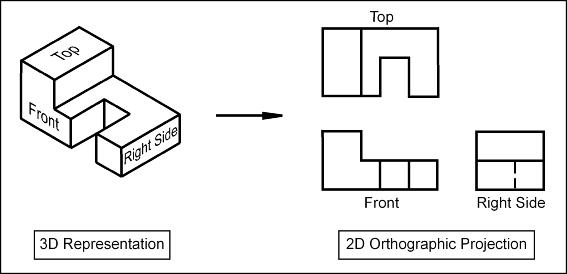
These were SO HARD for me and it took a lot of study and practice for me to understand them. But most of my classmates could just look at a 2D orthographic projection and understand what it looked like in 3D immediately. I felt so dumb and wondered if I shouldn’t be in engineering. Now I understand that I wasn’t stupid or lacking – it’s just my perception was different than theirs.
I won’t lie- there’s a part of me that is bummed that I won’t get to experience visualizations. Being able to visualize whatever you want seems really cool! But most of me isn’t too bothered by it. I’ve been like this my entire life, and I went nearly 40 years perceiving the world in my own way; why would I want something different now? I feel like it would be super distracting to see whatever I’m thinking. And you mean that I could have literal flashbacks for the traumatic stuff I’ve experienced? NO THANK YOU. They’ve done enough damage to my psyche as is; I’m grateful that I don’t have to re-experience them visually.
I’m admittedly intrigued at the idea of having a neurodiverse perspective that is not the majority experience. I’ve signed up for future research opportunities with the Aphantasia Network and look forward to any opportunities if and when they come my way. I’m sure that this will eventually be normalized for me, but for now, I’m fascinated by the idea of re-learning a world that I thought I’d already figured out.
Categories: aphantasia, Life


This is amazing. I vaguely remembered hearing about this but thought it was way more rare.
LikeLiked by 1 person
This is Tap btw lol
LikeLiked by 1 person
Yeah, I wonder if the 3-5% is just because a lot of people haven’t heard of it yet? I feel like way more people than that have it! But it’s so wild to re-learn everything with a new perspective!
LikeLike
Jennifer, that is so interesting. I could make up all sorts of balls and locations in the experiment we did, but I didn’t see then in my mind. I saw the after image in the Apple test and could figure out the 3D version of the smaller sections. I am just wondering as a painter about the ability of some painters to actually see a picture in the their head and put it on the canvas. I start painting on the canvas, changing it as go, editing from what I see on the canvas not seeing a picture in my mind at all. I am supposing this may be a spectrum condition. But, it helps in understanding what it means to be a visual learner and how actually seeing the object is so much easier to mentally manipulate than trying to manipulate what you hear but can’t visualize. Please keep me posted on what more you find out. Love you!
LikeLiked by 1 person
Jennifer – I wrote a reply but I don’t see it. I hope you get this. I commented that I could imagine the ball in all types of scenarios but not see a visual image in my mind. I saw the apple and can do the shape exercises fairly easy. As a painter though I marvel that some people see an image in their head they want to produce while I start painting and edit from what I see on the canvas. It is also interesting from a learning standpoint because it would be more more important for some students to have a concrete image they can mentally manipulate . I can’t imagine how nice it would be like to take an auditory prompt and from that form a mental picture in your head that could be then used to produce great thoughts. Love you mucho molto!
LikeLiked by 1 person
Hi Grandma Pat, thank you for posting! It is so interesting knowing about your experiences, thanks for sharing. One of the YouTube videos I watched when I was trying to figure out if I had it was from the perspective of an illustrator. She has aphantasia so she mentioned the same thing you did – she struggled with not being able to see an image in her head, but it didn’t stop her from a career in art. Love you too!
LikeLike
Jennifer – I saw my comment but it came out as anonymous. You will know which one is mine by its content. Grandma Pat
LikeLiked by 1 person
Twice…sorry. My original was anonymous too so I missed it.
LikeLiked by 1 person
Turns out my fiancé thinks the same way you do! He didn’t realise it was aphantasia either.
I bet a lot more people’s brains actually work the same, but we’re very rarely asked what exactly we ‘see’ in our heads so it’s just unrecorded.
LikeLiked by 1 person
That’s fascinating! I bet it’s more common than recorded.
LikeLiked by 1 person